Flutter vs React Native: which framework should you choose for your mobile app?
Do you want to create a beautiful mobile app for iOS and Android, but you’re not sure which technology to use to get the best performance in a short time and at a lower cost? If so, the answer to your needs may lie in one of the two technologies currently leading the ranking of cross-platform mobile frameworks: Flutterand React Native.
To fully exploit the potential of these tools, resorting to IT outsourcing is a preferred strategy: it allows you to immediately mobilize expert developers in these stacks, guaranteeing quality code and accelerated market entry, without the delays associated with specialized internal recruitment.
Which technology should you choose in 2022? Flutter or React Native?
To answer this question, we will:
- Provide an overview of Flutter and React Native.
- Compare the two technologies based on various decisive mobile development criteria.
- List the similarities between Flutter and React Native.
- Analyze and forecast the future evolution of both frameworks.
- List the points to consider when deciding what to choose for your mobile app in 2022.
Flutter vs React Native: 2022 Comparative Study
Nowadays, there are many application development tools, which complicates the choice of the right technology to ensure the best costs, deadlines, and performance.
Previously, to design a mobile application compatible with different operating systems (iOS or Android), it was essential to use native development. In other words, it was necessary to develop the application according to a programming language specific to the operating system and platform: Swift for iOS and Java for Android.
Today, there are what we call hybrid applications. These allow for creation on both Android and iOS using cross-platform technology. Thus, it is possible to compile a single source code into two native applications.

Flutter and React Native are two frameworks used for developing applications for mobile platforms (iOS, Android) from a single codebase. So, which of these two technologies should you choose?
| Flutter | React Native | |
|---|---|---|
| Created by | ||
| 2018 | Launch | 2015 |
| Dart | Language | Javascript |
| 135 000 ⭐ | GitHub Stars | 101 000 ⭐ |
| Yes ✅ | Cross-platform | Yes ✅ |
| Yes ✅ | Free & Open Source | Yes ✅ |
| Hot Reload | Speed | Fast Refresh |
| 5 Mo – | APK Size | 9 Mo – |
Technology Overview
What is Flutter?
Flutter is an open-source framework by Google that allows the development of applications for mobile (Android, iOS), web, and desktop platforms with a single codebase. It is maintained by Google and the Flutter community.
How mature is Flutter?
First announced by Google in May 2017 at the annual Google I/O event, the stable version of Flutter – Flutter 1.0 release – was launched in December 2018.
Thanks to substantial and regular support from Google, Flutter moved from beta testing to Flutter 1.0 quickly. The publisher didn’t stop there; even better, its teams have actively worked to strengthen the framework’s features, prioritizing improvements in stability, performance, and quality.
This allowed this nascent technology not only to be stable and mature in a short time but also to explode in the number of contributors.
Note that Flutter is currently in version 2.8.1 (December 2021) with 196 pull requests (code proposals sent by contributors) open on GitHub in January 2022, demonstrating its popularity within the developer community that uses and contributes to its improvement alongside the Google team.
What is React Native?
React Native is an open-source framework created by Facebook. It is based on React, Facebook’s JavaScript library; this technology is used to create user interfaces for mobile platforms.
React Native is a cross-platform language, meaning code written in React Native is sharable across platforms, allowing for efficient and simultaneous development on Android and iOS.
How mature is React Native?
React Native is a technology created by the Facebook team with the goal of providing a better mobile experience. This project was born in 2012 within Facebook after various instability problems appeared in the mobile version of Facebook, which was based on HTML5 (web version of the mobile app), leading the company to focus on finding a suitable alternative based on native development.
Facebook released the first version of the React Native JavaScript configuration in 2015 after many months of development. Christopher Chedeau, a front-end developer at Facebook, later revealed that React Native technology was already being used by Facebook for its Ads Manager App and Group App.
Taking the above into account, two things are certain: React Native is older and more mature than Flutter, and it benefits from a larger community. Not to mention that the Facebook team has had plenty of time to stabilize the API and focus on solving underlying issues.
Let’s not forget that Facebook is also working on several other notable areas of improvement for React Native:
- Lean Core – reducing an application’s size by moving optional components/features to separate repositories (to be added to an app as needed).
- TurboModules – for better management of native modules.
- React Native Fabric – re-architected user interface layer.
Flutter vs React Native: Two Frameworks in Their Own Right
| User Interfaces | Flutter provides its own UI components and widgets that are known to be beautiful. Additionally, Flutter was designed to support Material Design. Flutter apps look as good on the latest operating systems as they do on older versions. Furthermore, its compatibility with all devices is undoubtedly its greatest strength. ✔️✔️ | React Native offers basic standard tools, but the framework is nonetheless rich in libraries offering beautiful UI components adaptable to the need. |
| Documentation | Flutter has more user-friendly and easy-to-read documentation than React Native. Furthermore, Flutter provides comprehensive documentation on Continuous Integration / Continuous Deployment (CI/CD) which is done directly via the Flutter CLI. ✔️✔️ | React Native does not provide official documentation for automated application deployment to a platform, nor on CI/CD configuration. |
| Community Size and Activity | The Flutter community and contributors have exploded in number quite rapidly, but Flutter still has work to do in this area since Dart is much less used than JavaScript and the framework’s contributors are relatively less experienced than those of React Native. | React Native enjoys a large, active, and experienced community. This is due to the fact that the framework is based on JavaScript, a very widely used language, added to the framework’s relative seniority compared to Flutter. ✔️✔️ |
| Speed and App Performance | Unlike React Native, Flutter does not rely on bridges to interact with the native user interface. The framework uses the Skia graphics library, which supports compilation at the moment the user interacts with the application. Most of the work is done on the GPU (graphics processing unit); that’s why the Flutter user interface is smooth and offers 60 frames per second. ✔️✔️ | React Native is compiled into native code; it relies on a bridge between the JavaScript code and the device’s native ecosystem to execute the source code, making it less performant than Flutter. |
| Programming Language | Dart, an object-oriented programming language developed by Google, but which is much less adopted and used compared to JavaScript. | JavaScript dominates cross-platform mobile development thanks to its large community and mature ecosystem. For teams looking to take their React Native code to the next level, TypeScript enhances the robustness of your JavaScript mobile apps by adding static typing, which reduces errors right from the development phase. |
| Maturity | Despite the significant progress made by Flutter and the stability it has managed to achieve in such a short time, the framework still has catching up to do in terms of maturity compared to React Native. | React Native is more mature than Flutter, primarily due to its seniority. Indeed, the Facebook team has had ample time to stabilize it, although credit also goes to its active and experienced community. ✔️✔️ |
| Libraries | Even though Flutter receives significant support from Google, compared to React Native, the framework is less rich in libraries. Thus, a developer might be forced to design a feature themselves, which takes time. | React Native is very rich in libraries where a developer can find everything they need: NativeBase, React Native Elements, React Native Paper… ✔️ |
Commonalities Between Flutter and React Native
Cross-platform (Single Codebase)
With Flutter and React Native, developers can write a single codebase to develop a mobile application on iOS and Android.
This possibility gives them a considerable advantage over other mobile development frameworks, such as Swift (iOS) and Kotlin (Android), as it saves the time needed to complete a mobile application project for the different available platforms.
In this regard, Flutter has an advantage over React Native. With Flutter, a single codebase provides natively compiled applications for mobile platforms, as well as web and desktop.
Development Speed
Development speed is one of the key advantages of cross-platform frameworks. This logic naturally extends to the backend: Node.js accelerates the development of the API for your Flutter and React Native applications by sharing the same JavaScript ecosystem and integrating natively with the continuous deployment tools used on these stacks. This allows developers to see changes instantly, without having to rebuild the application.
Known as “Hot reload” on Flutter and “Fast refresh” on React Native, this feature also preserves the application’s state, avoiding the risk of losing it during a full reload, which accelerates the mobile application development process.
Open-Source
This is one of the main similarities; both frameworks are open-source (free access) and maintained by giant tech companies and active communities, which naturally contributes to the acceleration of their evolution.
50% Gain in Testing Time
Since they are hybrid frameworks, it is enough to write automated tests for a single platform and thus reproduce and execute the same for the other platform, which halves the time usually devoted to testing.
Analysis of the Future Evolution of Both Technologies
To attempt to draw a prediction regarding the evolution of these two frameworks, it would be relevant to study current comparative statistics:
Flutter vs React Native on Google Trends
According to the graph below generated by Google Trends, we can see the evolution of interest in Flutter and React Native, where we observe the great interest Flutter has obtained in such a short span of time, successfully overtaking React Native starting in August 2020.
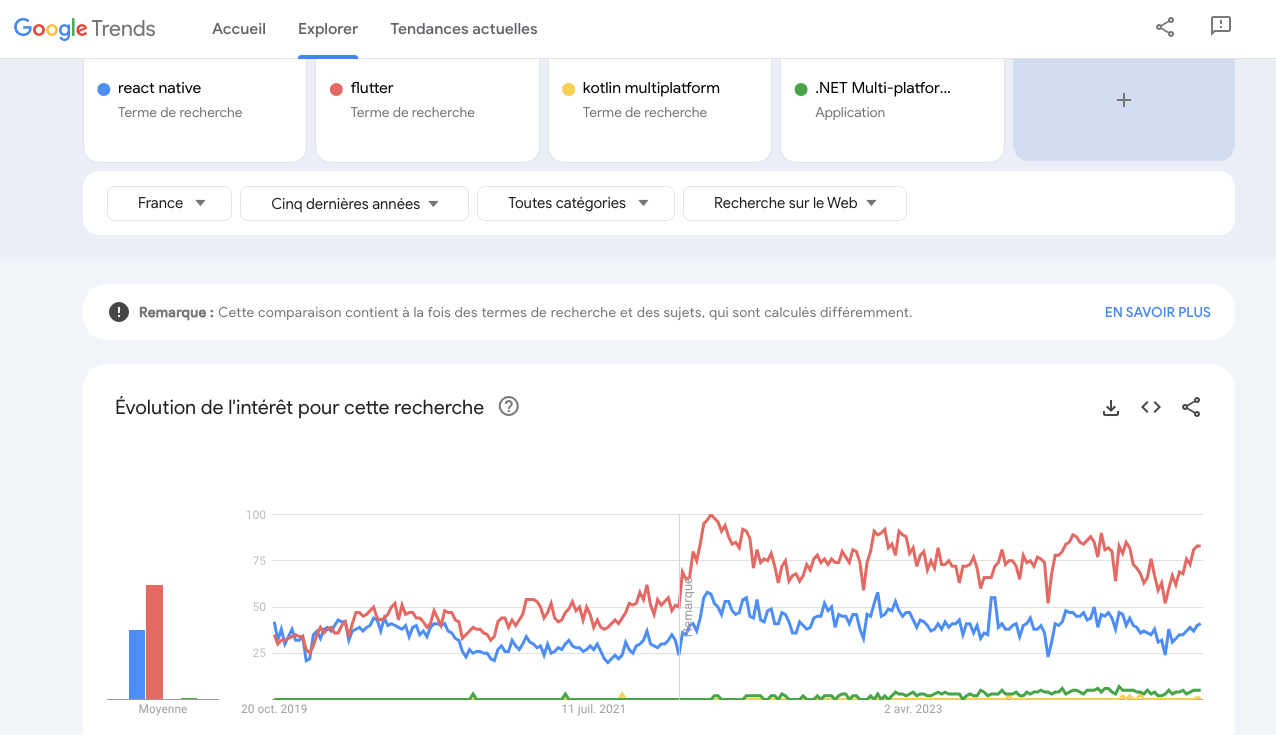
Interest evolution for Flutter and React Native over the last 5 years (October 2024)
You can view the up-to-date comparison of their evolutions at this link.
Popularity of Flutter and React Native on GitHub
On GitHub (the reference collaboration tool among developers), Flutter has 135k stars (popularity) and 20.4k forks; React Native has 101k stars and 21.7k forks. These figures reflect, on the one hand, the undeniable popularity of both frameworks and, on the other, the breakthrough of Google’s technology.
From the statistics presented above, we can draw the following conclusions:
- Flutter and React Native enjoy high popularity and monopolize the podium of the most used mobile cross-platform frameworks by developers over the last 3 years.
- There has been considerable interest in Flutter over these last 3 years.
- A continuous rise in the use of Flutter, making it the most used mobile cross-platform framework in early 2022.
Flutter vs React Native: What to Choose for Your App in 2022?
Timelines, performance, and cost control are the three pillars of any successful mobile project. This requirement doesn’t apply only to the front end; the back end plays an equally critical role. Ruby on Rails accelerates the development of your mobile app’s back end, reducing time-to-market thanks to its conventions that eliminate repetitive configuration tasks..
Flutter and React Native both offer an environment that ensures these 3 key aspects. So, how do you choose? Which technology is best suited for your project?
- Are your developers comfortable with JavaScript? If so, choosing React Native will save you a lot of time.
- Have they worked with Dart? If so, using Flutter will be much easier for them.
Ultimately, the choice of framework is a matter of affinity and depends directly on your team’s skills.
Of course, establishing a requirements document is a crucial step to better define your project’s needs and thus make a better choice regarding the appropriate technology.
If you still have questions regarding Flutter and React Native, don’t hesitate to contact us via the form for assistance.