Native, hybrid, or web application: choose according to your project
Your project to create a mobile application is finally taking shape, and you’ve discovered there are several types of apps? Don’t want to blow your budget on an app that doesn’t meet your needs? Native, hybrid, or web app? It’s a legitimate question.
It’s tempting to opt for hybrid development or a progressive web app for the speed of the process, and especially because of the significantly higher cost of native development.
Of course, it’s not that simple. Other factors come into play: app performance, user experience, deployment time, product longevity, etc.
That’s not all; you must also consider the context of use (personal or professional, target audience…).
As you’ve understood, jumping in headfirst can be very expensive. The purpose of this article is precisely to help you avoid those missteps.
Thus, throughout this article, we will look at what native, hybrid, and web applications are, as well as how to make a wise choice based on the criteria mentioned above. Before that, here is a reminder about app development:


A quick reminder on application development
A mobile application is, above all, software. It is a program available for download on mobile devices (smartphones and tablets).
This program contains a file that will be installed and executed by the OS (operating system) of your device.
Different development languages are used for coding this file, each specific to a type of device. For example:
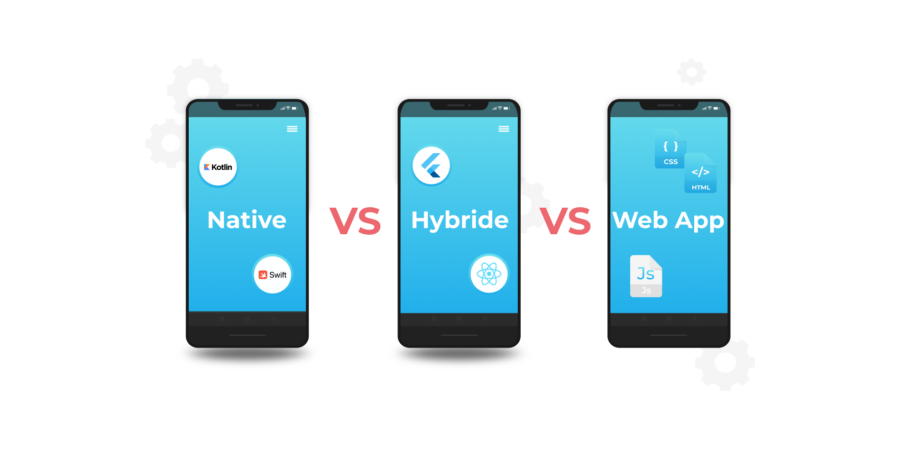
- Java and Kotlin are used for mobile devices running on Android.
- Objective C and Swift are used for mobile devices running on iOS (Apple).
Web applications are application software hosted on a server and accessible via browsers.
Their advantage is that they do not require downloading. For their development, several languages are used, such as:
- Python;
- Ruby;
- Javascript;
- and PHP.
What is a native application?
A native application is specifically developed for an operating system used on a smartphone or tablet (Android, iOS, Windows…).
Generally, developing a native application allows access to all features of the specific operating system (Camera, GPS…) and also allows for more comprehensive applications, especially compared to web applications.
As you may have realized, a native application is only accessible to users of the targeted operating system.
Therefore, if you want to reach a wider audience (using other operating systems), it will be necessary to develop several native applications.
Most applications—at least the most ambitious ones, except in exceptional cases—are developed for at least iOS and Android.
What is a hybrid application?
The combination of web technology and native development gave birth to hybrid applications. They contain elements from native applications as well as elements from web applications.
HTML, JavaScript, and CSS are the languages of hybrid mobile applications. Special platforms then allow hybrid applications to be placed within a native environment.
Once deployed, downloaded, and installed, the hybrid application will be accessible on the various operating systems for which it was developed.
Ultimately, what you need to remember is that for hybrid application development, the same code is used for the different target operating systems (iOS and Android). As a result, they require much less development time.
There are also what we call cross-platform applications. They are similar to hybrid applications with one exception.
Indeed, cross-platform applications compile source code into native applications, whereas hybrid applications, as mentioned before, integrate web content into a native container.
What is a web app or progressive web app?
Web applications or progressive web apps are directly accessible online through web browsers without the need for downloading or installation.
Furthermore, updates to these applications are invisible to the user. Just like websites, web applications are hosted on a server and operated using widgets.
Web application development is done using web development languages. These apps are generally used for simple projects or optimized website versions.
For example, webmail, blogs, and content management systems are web applications.
It is also possible to find search engines, online games, and e-commerce software in the form of web apps.
So, how to choose between web, native, or hybrid?
It’s always good to know more about what will represent the main support for your project (your app), but you still need to know how to choose the right type.
To find out if you need a native, hybrid, or web application, ask yourself the following questions:
- What budget have you allocated to the development of your application?
- How much time do you have?
- What is your business goal?
- What is your target audience?
- What features do you need?
Now that you have answered these questions, here are some comparison points between the different types of applications:
| Native Application | Hybrid Application | Web Application | |
| Development Cost | High. | Lower than a native application, but can lead to higher maintenance costs. | Low cost, and profitable application due to easier maintenance. |
| Development Time | Long (repetition of the development process for each OS). | Shorter than a native application. | Fastest development. |
| Monetization | It is not possible to sell the app. Advertising is possible. | Advertising, in-app purchases, and paid apps are possible. | Advertising, in-app purchases, and paid apps are possible. |
| Platform Compatibility | Compatible with only one platform. | Compatible with all platforms. | Compatible with all platforms. |
| Features | Custom-made | Custom-made (subsequent addition of some features may be impossible). | Does not offer all mobile device features. |
Aventique: Your Project’s IT Partner
If you have made your choice regarding the type of application you wish to develop—native, hybrid, or web—the Aventique teams will be happy to let you benefit from their expertise.
As a web and mobile development agency with over 10 years of experience, Aventique provides you with teams accustomed to complex projects and skilled in the latest technologies.
If you wish to outsource the development of your mobile application, our teams will be happy to accompany you throughout your project.
If you are looking for a developer to join your teams during the development of your application, feel free to consult our nearshore staff augmentation offer.
Whatever your request, we offer a solution that adapts to your needs. All that’s left is to send us a message ⬇️