Aventique develops your mobile application with Flutter
Aventique develops your custom mobile applications with Flutter. From UX design to deployment on iOS and Android, we create high-performance, scalable, and maintainable applications from a single codebase. Our approach: starting from your business objectives, designing a smooth user experience, then delivering a robust solution with optimized time-to-market and controlled TCO.



Getting to know Flutter
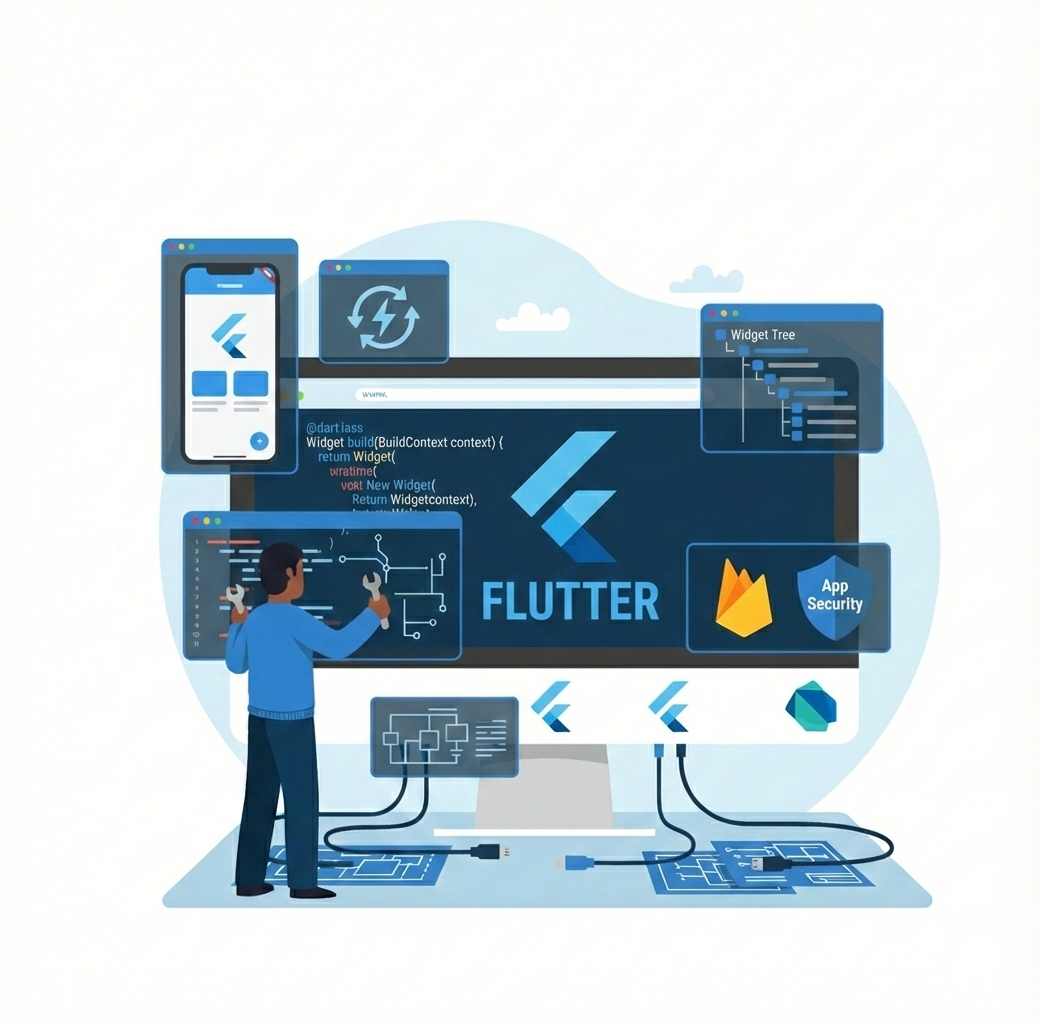
Flutter is a mobile development technology based on the Dart language officially launched to the public by Google in 2018.
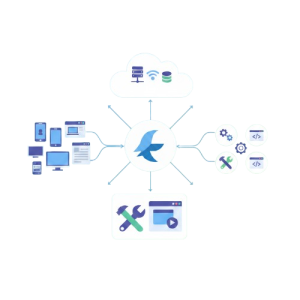
This open-source framework enables the development of hybrid mobile applications compatible with multiple systems from a single Dart source code.

2.0
While version 1 was focused on iOS and Android mobile development, version 2 launched in 2021 includes web development as a new feature.

1000 Contributors

65,000 Contributors
Although Flutter is relatively young compared to React Native, this framework is evolving rapidly and represents significant competition with its new features.
The Flutter community greatly contributes to its rapid evolution, with nearly 1000 contributors on GitHub and 65,000 active contributors to the Flutter tag on Stack Overflow.
Advantages of Flutter development
1. More efficiency and less effort
With Flutter, only one source code in Dart language is needed for custom Android and iOS mobile app development: 2 times more efficiency, 2 times less time.
Flutter source code is compiled into JavaScript, ARM or Intel, ensuring smooth performance on all devices.
2. Customizable blocks
Using Flutter, developers combine development and design for a perfectly smooth rendering. The manageability of widgets offered by the framework facilitates the implementation of the desired design. Every corner of the screen can be controlled and customized to achieve a harmonious interface.
3. Speed of reaction
One of the advantages of Flutter development is its Hot Reload option which allows you to build the application code in less than a second. No distractions, continuous concentration and guaranteed developer reactivity.
The speed of compilation facilitates the testing phase and allows for more iterations to ensure the most stable version of your application.
4. Adopted by major companies
In addition to being Google’s first development choice, several major companies have chosen to migrate to Flutter for their application development: Square, Groupon, Alibaba, Tencent…
Disadvantages with Flutter
Flutter benefits from a large but smaller community compared to technologies like React Native.
Some specific libraries may still be missing, and the initial application weight is slightly higher.
But these constraints are minimal compared to its advantages in speed, visual quality and productivity. With its very active community, most of these points are continuously improving.
What is the difference between Flutter and React Native?
Both technologies share the same philosophy (one code for multiple platforms), but they rely on different foundations.
React Native relies on a JavaScript bridge to communicate with native components, while Flutter draws the interface directly via its own graphics engine.
Result: Flutter often offers better visual consistency, fewer compatibility bugs, and better overall performance on rich or animated interfaces.
However, React Native remains an excellent choice due to the very large React and React Native community and the JavaScript base.
At Aventique, we master both, and we choose the most relevant technology according to your context.
Flutter Success Story: Google Pay
Context
Google Pay is a payment method used by over 100 million users worldwide. However, from a development perspective between Android and iOS, the success of operations required 1.7 million lines of code: huge!
To ensure the expansion of Google Pay into new countries and the evolution of features in both systems, Google chose to migrate to Flutter. This migration led to a remarkable change in team productivity: reduced effort and time savings.

“Everyone loved Flutter – you could see the thrill on people’s faces when they talked about how quickly it was possible to build a user interface.“
– David Ko, Director of Engineering, Google Pay
70%
Less development effort
35%
Fewer lines of code

Flutter Maturity: Why major companies trust it
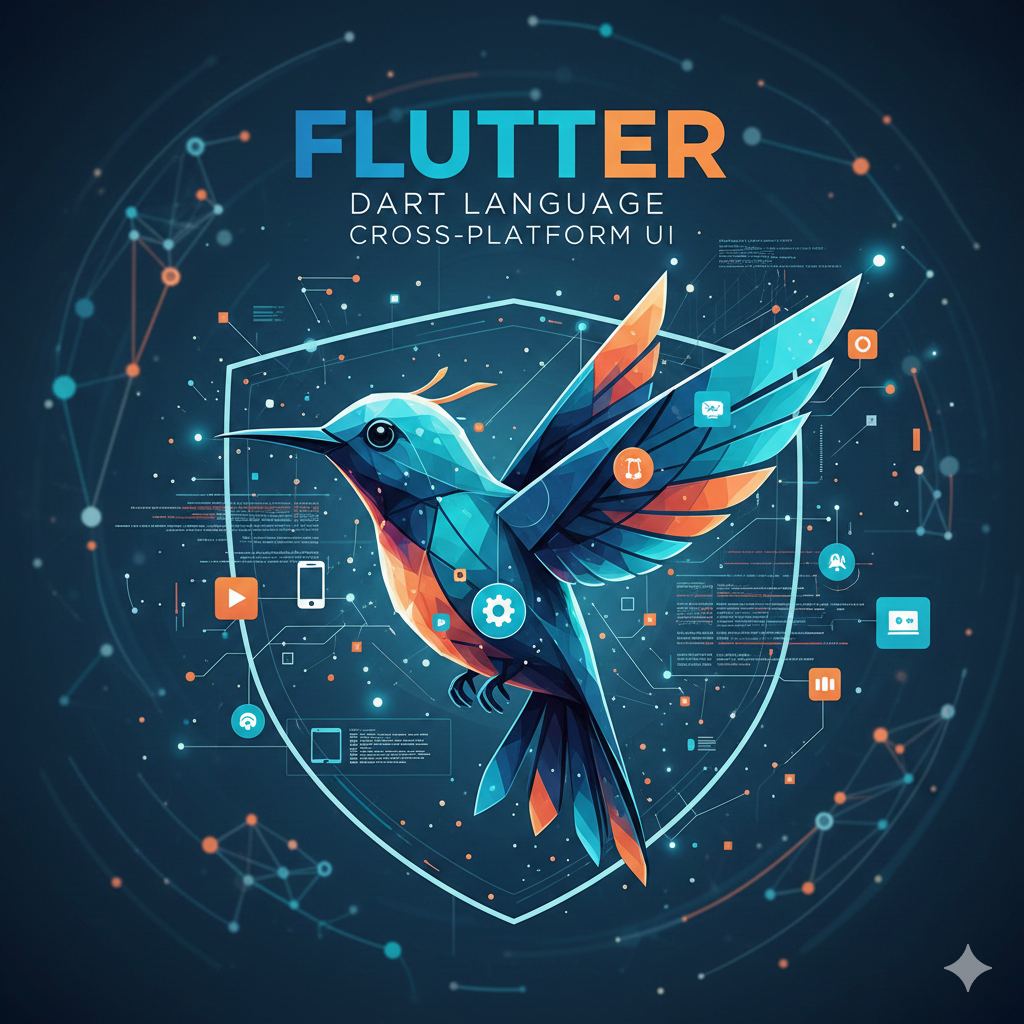
Flutter’s maturity level has evolved considerably since its launch by Google in 2018. Today, it is a stable, proven framework widely adopted by businesses, startups, and even major international groups.
Flutter is no longer just an experimental tool: it’s an industrial solution, used for high-traffic applications and strategic products.
Thanks to its high-performance graphics rendering engine (Skia), Flutter offers smooth animations, a consistent user experience across all devices, and performance very close to native. Applications built with Flutter stand out for their execution speed, responsiveness, and superior visual quality, even on mid-range smartphones.
Using Flutter in complex projects
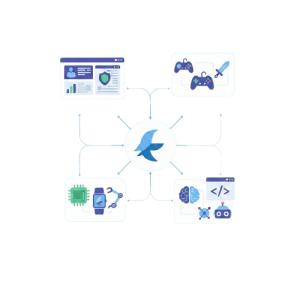
Flutter supports robust architectures, REST APIs, complex backends, and third-party integrations. It can handle authentication systems, payments, geolocation, notifications, or video streams. Thanks to its stable engine, it can integrate into enterprise environments with strict security and performance constraints.
A mature ecosystem adopted by market leaders
The framework also benefits from a robust ecosystem: thousands of packages and plugins are available to accelerate development, while remaining compatible with best security and maintenance practices.
Its “Hot Reload” mechanism allows developers to test and adjust code in real-time, which greatly reduces time-to-market and improves the final product quality.
In France and internationally, many companies have chosen Flutter for its stability and performance: Leclerc, Decathlon, Crédit Agricole, BMW, Alibaba, and Google use Flutter for some of their applications. This level of adoption demonstrates the technological maturity of the framework and the confidence that major market players have in it.
In summary, Flutter combines the power of modern technology, the quality of native rendering, and the reliability of a framework supported by Google, making it a choice solution for any ambitious, sustainable, and scalable mobile project.
Choose Aventique for your Flutter project
At Aventique, we combine technical expertise and product vision. Our Flutter developers work hand in hand with experienced project managers to align technology with your business objectives.
We support you from the analysis phase to post-launch maintenance, with an agile, transparent, and results-oriented approach.
FAQ - Flutter Agency
When to choose Flutter for developing your application?
Flutter is particularly recommended when looking to quickly develop a multi-platform application while controlling costs.
It’s an excellent option if you’re starting a new project or an MVP, as a single codebase allows deployment on iOS and Android simultaneously.
If you already have internal web development skills, your teams can easily gain expertise in Flutter, thanks to its Dart language, similar to JavaScript.
It’s also a good solution if you have an existing application that’s difficult to maintain: Flutter allows you to modernize the experience without starting from scratch, while keeping your current backend.
Finally, Flutter is perfectly suited for companies seeking a sustainable, scalable and high-performance product, supported by a solid ecosystem and regular updates from Google.
Does Flutter reduce development costs?
Yes, and significantly.
Flutter development allows you to reduce costs by 30 to 40% compared to two separate native developments (Swift for iOS + Kotlin for Android).
The savings don’t stop at the creation phase: maintenance, evolutions and updates are also much simpler because there’s only one code to evolve.
For startups or SMEs, this represents a strategic opportunity to concentrate budgets on growth, marketing or user acquisition.
Is performance comparable to a native app?
Yes. Flutter compiles its Dart code directly into native machine code, eliminating intermediate layers.
Its graphics engine, Skia, is the same one used by Chrome or Android.
This guarantees smooth animations at 60 fps, minimal latency and excellent responsiveness, even on entry-level devices.
For the majority of use cases — e-commerce, messaging, internal management, media, booking —, users perceive no difference from a native app.
And for extreme needs (3D, AR/VR, intensive computing), it’s possible to integrate modules in Swift or Kotlin, to combine performance and flexibility.
Is Flutter a sustainable technology?
Flutter is a project supported by Google, at the heart of its multi-platform strategy.
It’s already used for Google’s internal products and powers the new generation of OS Fuchsia.
The community is very active, updates are frequent, and available libraries number in the thousands.
Flutter is one of the most promising long-term frameworks, with continued adoption by businesses and independent developers.
How long does it take to develop a Flutter application?
The timeline depends on the scope, but Flutter generally allows you to reduce total time by 25 to 40%.
An MVP can be launched in 8 to 12 weeks, versus 4 to 6 months for native development.
Flutter’s modular approach facilitates iterations, which allows for rapid delivery of a testable version, then adding features continuously.
Is Flutter suitable for an MVP?
Yes, Flutter is ideal for an MVP (Minimum Viable Product).
Thanks to its modern architecture and high-performance rendering engine, Flutter enables the design of a first version of an application (MVP) in record time, without compromising visual quality or user experience.
Development teams can quickly design elegant, smooth and consistent interfaces on iOS and Android, with a single codebase. This means less time spent on development, fewer bugs and better controlled budget.
It’s a major asset for startups and innovative companies that want to test a concept, validate an economic model or convince investors before engaging larger budgets.
Once the MVP is launched, Flutter also facilitates product evolution: it’s possible to add new features, improve the design or integrate external tools without having to rewrite everything.
In France, many startups have made this choice to accelerate their market entry:
👉 Frichti (foodtech) to test fast delivery concepts,
👉 Heetch (mobility) to deploy lighter versions of its app,
👉 Lydia (fintech) for certain cross-functional features,
👉 or Vestiaire Collective (retail) which experiments with Flutter on components of its app.
Flutter therefore offers a perfect framework for moving from idea to functional product, with an excellent balance between speed, quality and scalability.
Can Flutter be used for complex projects?
Yes. Flutter supports robust architectures, REST APIs, complex backends and third-party integrations.
It can handle authentication systems, payments, geolocation, notifications or video streams.
Thanks to its stable engine, it can integrate into enterprise environments with strict security and performance constraints.
Can Flutter be integrated into an existing app?
Absolutely. Thanks to the “Add-to-App” feature, Flutter allows you to add part of the code to an existing native app.
It’s an ideal approach for companies that want to progressively modernize their application without completely rebuilding it.
What about maintenance?
One of Flutter’s major advantages lies in source code centralization: a single codebase for two platforms (iOS and Android). This significantly reduces complexity and maintenance-related costs.
Unlike native approaches where each update must be performed separately, Flutter allows you to fix a bug, improve a feature or enhance security in a single intervention. The risk of divergence between iOS and Android versions is therefore almost nil, which guarantees a consistent user experience across all devices.
Additionally, the framework benefits from a very active ecosystem, supported by Google. Regular SDK updates, compatibility with new operating system versions and the quality of third-party libraries make it a sustainable and long-lasting solution.
This translates, for companies, into a more stable product in the long term and simplified maintenance, even for complex projects or those with high user volumes.
At Aventique, we ensure complete post-launch support:
corrective and evolutionary maintenance,
application performance monitoring,
security updates and compatibility with new iOS and Android versions,
continuous integration for new features.
Our objective is clear: to guarantee the sustainability, security and performance of your Flutter mobile application over time, while allowing you to evolve serenely at the pace of your business needs and user feedback.
Is Flutter compatible with the App Store and Google Play?
Yes. Flutter generates 100% native applications compatible with Apple and Google requirements.
Publishing, updates and validation on the stores follow the same process as a classic app.
No visibility or performance limitations are imposed.
Does Flutter give access to phone features?
Yes, fully: camera, GPS, sensors, push notifications, Bluetooth, NFC, etc.
And if a feature doesn’t yet exist in the Flutter catalog, it can be developed natively and easily integrated.
It’s an extremely flexible development framework.
How does post-launch support work?
The launch marks a new phase: product life.
We support our clients long-term with continuous maintenance and evolution packages:
Flutter / Dart updates,
bug fixes,
performance and security monitoring,
development of new features based on user feedback.
Your application remains high-performing, up-to-date and stable over time.
PROJECT METHODOLOGY
Every project starts with an in-depth listening phase.
We seek to understand not only your idea, but also your market, your users and your business objectives.
This step allows us to define:
the technical strategy (architecture, library choices, backend integration),
the project roadmap,
and the most suitable collaboration model: fixed price, agile or time and materials.
Our approach is based on transparency: each Flutter project starts with a clear vision of the scope, priorities and deliverables.
Our design team creates aesthetic, smooth and user-centered interfaces.
Flutter allows exceptional creativity thanks to its graphics engine, and we fully exploit this flexibility to create unique and consistent experiences on all platforms.
Each screen is designed to:
maximize conversion,
streamline user journeys,
and strengthen brand perception.
Flutter development is organized in short sprints (SCRUM), allowing frequent deliveries and rapid adjustments.
Each sprint includes:
feature development,
technical review,
client demo,
and iterative validation.
This method guarantees total transparency, better reactivity to feedback, and consistent code quality.
Before production release, we perform rigorous testing:
unit and functional testing,
compatibility on different devices,
performance, security and stability.
Our QA team simulates real use cases to anticipate any malfunction.
The goal: guarantee a stable, smooth and bug-free Flutter application from the first version.
We handle publishing on the App Store and Google Play, respecting their guidelines.
But our mission doesn’t stop there: we provide corrective and evolutionary maintenance, technical updates, and continuous performance monitoring.
We also implement monitoring tools (Crashlytics, Firebase, etc.) to quickly identify and fix any incident.
The objective: make your Flutter application a sustainable, profitable and scalable product.