Aventique - React Native/JS Development Agency
At Aventique agency, we develop your hybrid Android/iOS mobile applications with React Native and custom web applications with React JS. From UX/UI design to deployment, we manage the entire cycle: architecture, development, API integrations, testing, and maintenance.



Getting to Know React
React is an open-source framework based on the JavaScript library that allows the development of web and mobile applications compatible with multiple systems from a single JavaScript source code.

While React JS (React) enables the development of websites and web applications, React Native is a technology developed by Facebook in 2015 aimed at facilitating mobile application development.
React Native, like React JS, is an open-source framework based on JavaScript that allows for the hybrid development of Android and iOS mobile applications.
Benefits of Developing with React Native
1. Time Saving
React Native allows for the creation of applications compatible with both iOS and Android from a single source code. This implies a reduction in the time and effort required for native mobile app development, which previously had to be done separately using different languages.
2. Uncompromised Adaptation
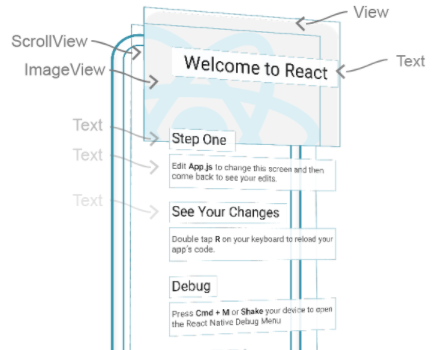
React Native enables you to create truly native applications without compromising the user experience. It provides a set of native components for each OS that directly correspond to native interface components, whether for iOS or Android.

3. Fast Refresh
Based on JavaScript, React Native allows you to build the application code at high speed (testing it on a simulator or device). No more waiting for native builds to finish, which results in speed and agility during development.
4. Integration or From Scratch
React Native can be used in already established Android and iOS projects just as it allows for the creation of a brand-new application from scratch. Indeed, React and JavaScript components “wrap” existing native code and interact with native APIs for complete compatibility.
5. Beyond Android and iOS
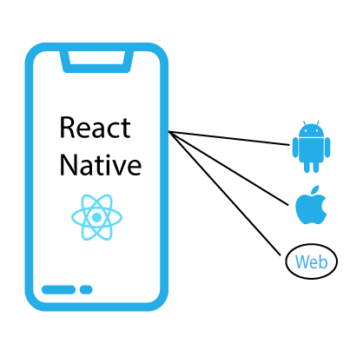
The active React Native community constantly delivers exciting new projects and explores platforms beyond Android and iOS, with variants like React Native Windows, React Native macOS, and React Native Web.
In fact, React Native web support has recently emerged, making RN a direct competitor to Flutter. Now, one can create a web version + a mobile application of a service from the same React Native source code.
6. Hyper-growth Community
Thanks to dev communities like GitHub and Stack Overflow (over 77,000 active contributors to the React Native tag), developers can get help in case of issues.
In 2021, the React Native community on GitHub exceeded 2,260 contributors and 800,000 users. The technology is now supported by contributions from major global names, including Callstack, Expo, Infinite Red, Microsoft, and Software Mansion.

2260 Contributors

77,000 Contributors
7. Adopted by Big Names
In addition to being the primary development choice for the Meta group, several major names have chosen React Native for their application development: Instagram, Skype, Discord, Uber…
React Native vs React: Differences, Benefits, and App Types
React vs React Native: Essential Differences
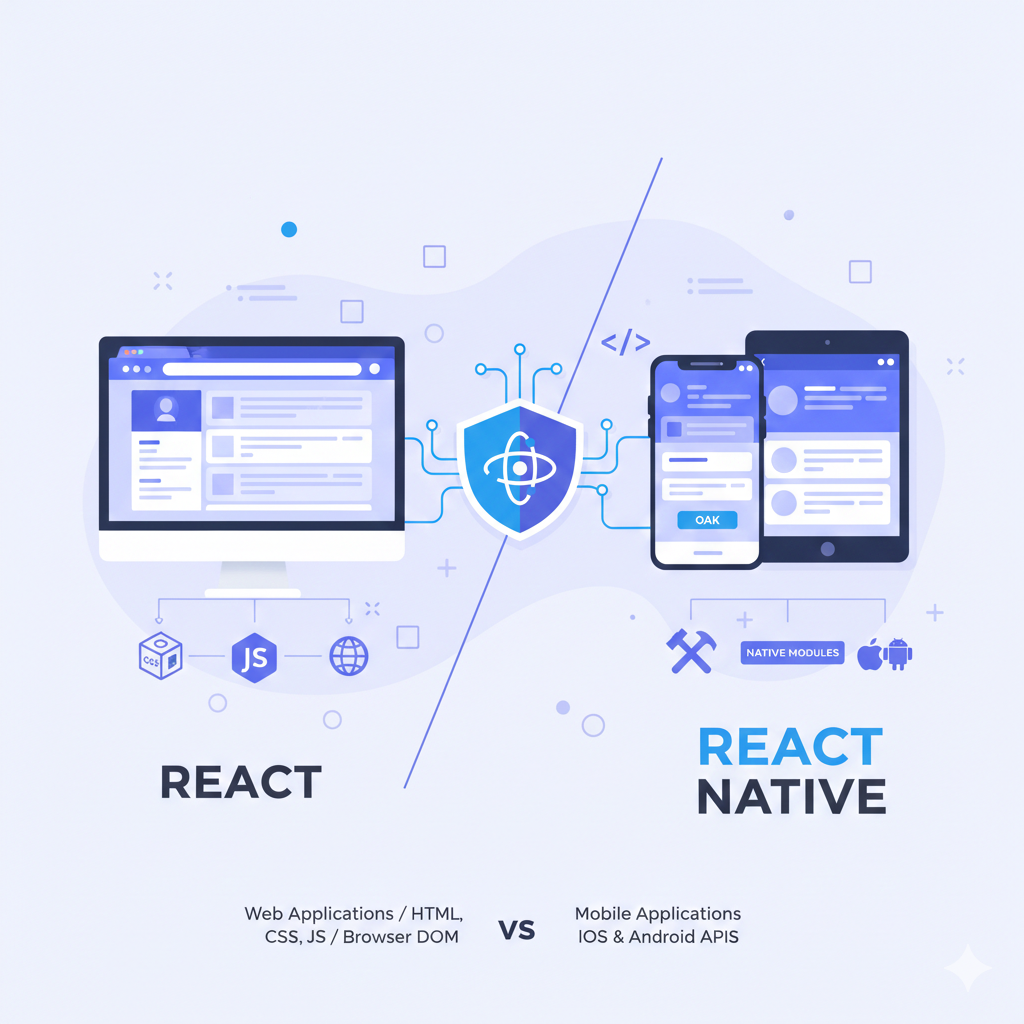
React is a JavaScript framework intended for web development, while React Native is designed for mobile applications. Both rely on the same logic of components and code reusability. Thus, a team proficient in React can very easily adapt to React Native, facilitating collaboration between web and mobile projects.
Types of Applications Developable with React Native
React Native is extremely versatile. It is used to create e-commerce applications, booking platforms, delivery apps, internal business tools, or social networks.
Its great flexibility also allows for the design of custom applications meeting specific business needs, while maintaining an excellent level of performance.
Why Choose React Native for Mobile App Development?
React Native is a powerful technology that allows for the creation of high-performance mobile applications from a single code for iOS and Android. This means reduced development time, optimized costs, and a fluid, consistent user experience across both platforms.
It is the ideal solution for companies that want to launch an application quickly without multiplying technical teams.
Integration and Performance of React Native and React.js with Your Existing Systems
The Benefits of React.js for Your Modern Web Applications
React.js offers fast loading, smooth navigation, and a responsive interface.
It is a preferred choice for companies that want to offer a user experience close to that of a mobile application, directly in the browser. Interfaces built with React are also easier to maintain and evolve over time.
Connecting React Native to Your Existing Backend
React Native integrates very well with existing APIs, whether they are developed with Node.js, Laravel, Symfony, Django, or .NET.
This allows companies that already have an infrastructure in place to modernize their mobile front-end without rebuilding everything. It is an agile, economical, and progressive approach.

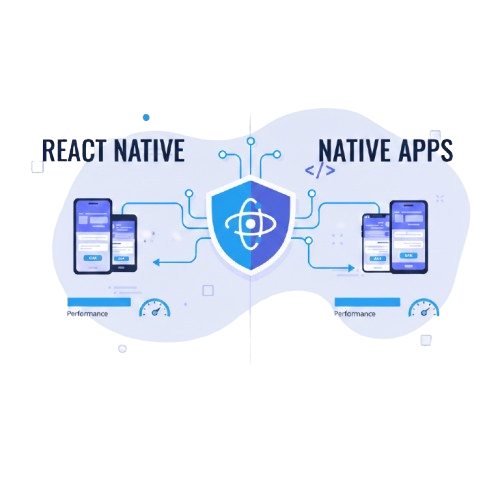
React Native Performance Compared to Native Applications
In the vast majority of cases, the performance of a React Native application is almost equivalent to that of a natively developed application. React Native uses real iOS and Android components, compiled directly into native code, guaranteeing fluidity and responsiveness. For most projects (e-commerce, marketplace, social network, internal tool), the difference from pure native development is imperceptible to the end-user.
For highly demanding projects (3D games, augmented reality, real-time image processing), it is possible to combine React Native with native code in Swift or Kotlin. This hybrid approach retains development speed while optimizing performance on specific modules, offering an excellent compromise between performance and simplified maintenance.
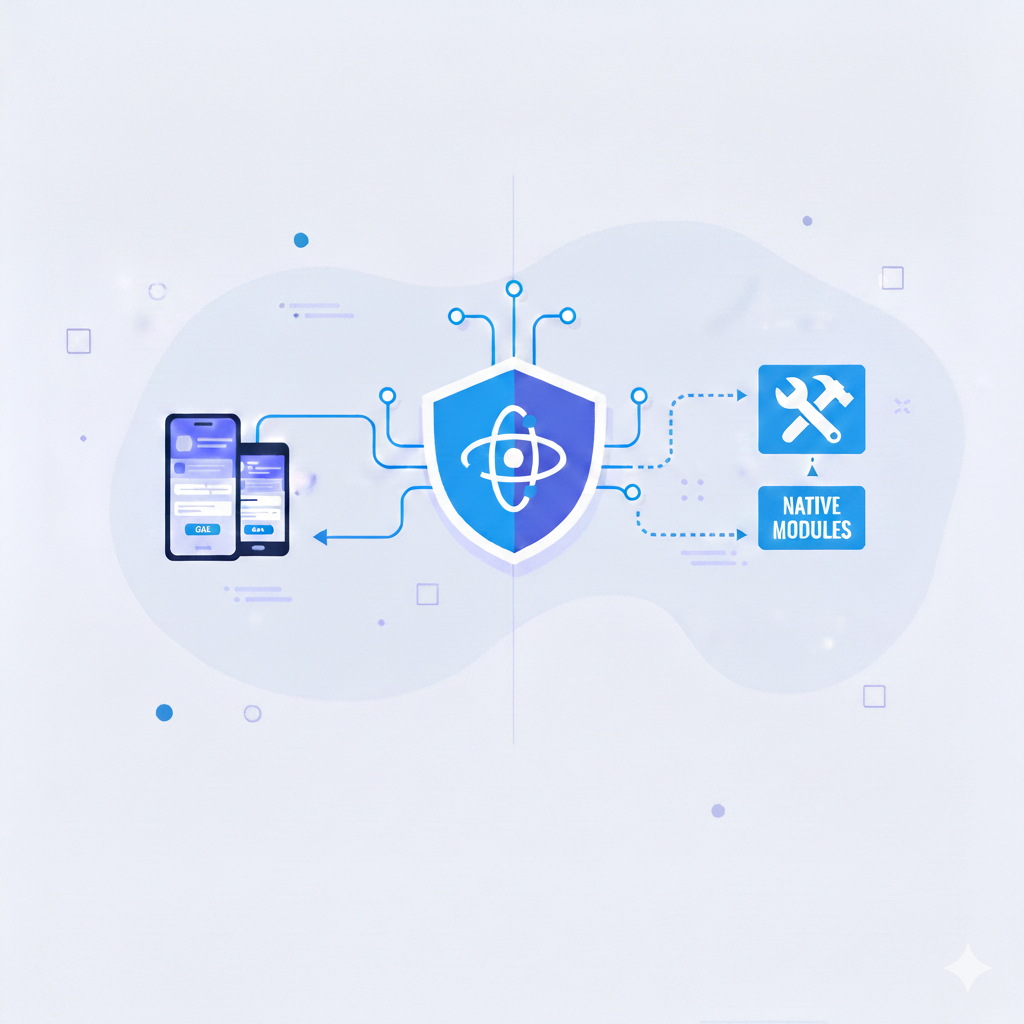
Integration of Native Modules in React Native
React Native allows for the integration of native code directly into your project to access advanced smartphone functions: camera, GPS, NFC, Bluetooth, biometrics (Face ID, Touch ID), push notifications, or sensors (accelerometer, gyroscope). This flexibility ensures that no technical limitation hinders your project, while keeping up to 95% of shared code between iOS and Android.
The Native Modules system bridges the gap between JavaScript and native APIs. You can use existing community libraries or create your own custom modules. Companies like Meta, Microsoft, Shopify, and Tesla use React Native for their applications, proof of its reliability at scale and its ability to manage advanced native features.
React Native vs React: Differences, Benefits, and App Types
Aventique is much more than a technical agency: it is a strategic partner.
We combine expertise in React / React Native, user experience, and business vision to create high-performance, stable, and results-oriented applications.
Our support ranges from design to maintenance, with a team that has proven itself on numerous mobile projects based on React Native and web projects using React.
React Native FAQ
Can a React Native app be published on the App Store and Play Store?
Absolutely. React Native applications are published in the same way as classic native apps. At Aventique, we support our clients throughout the process, up to submission and validation on the Apple and Google stores, following all best practices (icon optimization, screenshots, metadata, etc.).
What is the average timeframe to develop a React Native application?
The timeframe varies according to the project’s complexity, but it is generally estimated between 2 and 6 months for a complete application. Our teams work according to an agile approach, with short and measurable development sprints, to ensure constant monitoring and regular deliverables.
How much does an application developed with React Native cost?
The cost of a React Native application depends on several factors: the functional scope, the level of design customization, the technical complexity (API integration, authentication, geolocation, payments, etc.), and the desired quality of animations or user experience.
By choosing React Native, companies often realize substantial savings because a single codebase allows for deployment on both iOS and Android. On average, this represents 30 to 40% savings compared to native development conducted separately for each platform.
But beyond the initial cost, this approach also proves to be more profitable in the long term:
- Updates and functional evolutions are faster to implement,
- Maintenance is simplified thanks to common code,
- And visual and technical consistency between both versions (mobile and tablet) is guaranteed.
It is therefore an ideal solution for startups that want to launch their product quickly without compromising quality, as well as for SMEs looking to optimize their return on investment while remaining agile in their digital strategy.
Can an existing app be modernized with React Native?
Yes. It is possible to gradually integrate React Native into an existing application without starting from scratch. This is a method widely used by companies that want to modernize their technology stack without interrupting their business.
Why is React Native so popular with startups?
Because it allows for the rapid design and launch of an MVP (Minimum Viable Product), React Native is particularly suited to companies that want to validate an idea before investing heavily. This approach consists of developing a first functional version of the application, focused on essential features, in order to test the market and measure real user interest.
Once the initial feedback is collected, the product can evolve in an agile manner: refining the user experience, adding relevant features, improving performance or design. This iterative process provides an ideal framework for learning fast, adapting, and progressing without starting from scratch.
This explains why many startups choose React Native: they can move quickly, adjust their strategy based on concrete feedback, and keep a controlled cost structure throughout development.
Do large companies use React Native?
Yes, absolutely — and major ones at that. React Native is now adopted by the world’s leading web and mobile players: Facebook, Instagram, Pinterest, Uber Eats, Discord, and Shopify are among the companies using it to accelerate their development while ensuring a smooth experience on iOS and Android.
But the technology has also attracted many French companies in various sectors: Le Monde, Doctolib, BlaBlaCar, Leboncoin, and Back Market rely on this technology to evolve their applications faster while controlling costs.
React Native is now a mature, stable, and proven technology, supported by an extremely active international community and a powerful ecosystem of tools. It is this combination — speed, reliability, and flexibility — that makes it a preferred choice for startups and large companies alike looking to innovate faster while maintaining excellent user experience quality.
Can the design of a React Native application be fully customized?
Yes. The user interface can be entirely custom-made, from minimalist design to a high-end experience with animations, transitions, and micro-interactions. We pay special attention to UI/UX design to offer an application that is as beautiful as it is functional.
Is React Native secure?
Yes, provided it is developed according to best practices: encryption of sensitive data, secure authentication, and server-side verification. At Aventique, security is an integral part of the development process, from the design phase.
What happens after the application goes live?
Yes, exactly. The deployment of the application is just one step — true success is played out over the long term. That’s why we offer complete and structured post-launch support.
Our team ensures:
- continuous maintenance, whether corrective or evolutive,
- regular updates of React and React Native frameworks to guarantee compatibility and performance,
- close monitoring of security and performance to anticipate any issues,
- and the addition of new features inspired by user feedback and evolving business needs.
Each project benefits from a dedicated project manager and a responsive technical team to keep the application alive daily. The goal: ensure the longevity, stability, and modernity of your product, far beyond the initial launch.
Can application performance and usage be tracked?
Yes, using analysis tools like Firebase, Amplitude, or Mixpanel. These solutions allow for tracking user behavior, identifying points for improvement, and optimizing conversion or retention rates.
Can we have a web and mobile version of the same product?
Yes. React (for web) and React Native (for mobile) share the same philosophy and allow for reusing part of the code. This guarantees a fluid and consistent user experience, regardless of the device.
Does React Native allow for offline mode?
Yes, this is a frequently requested feature. Essential data can be stored locally to allow the user to use the application even without an Internet connection. This is a key advantage for field, delivery, or inspection applications.